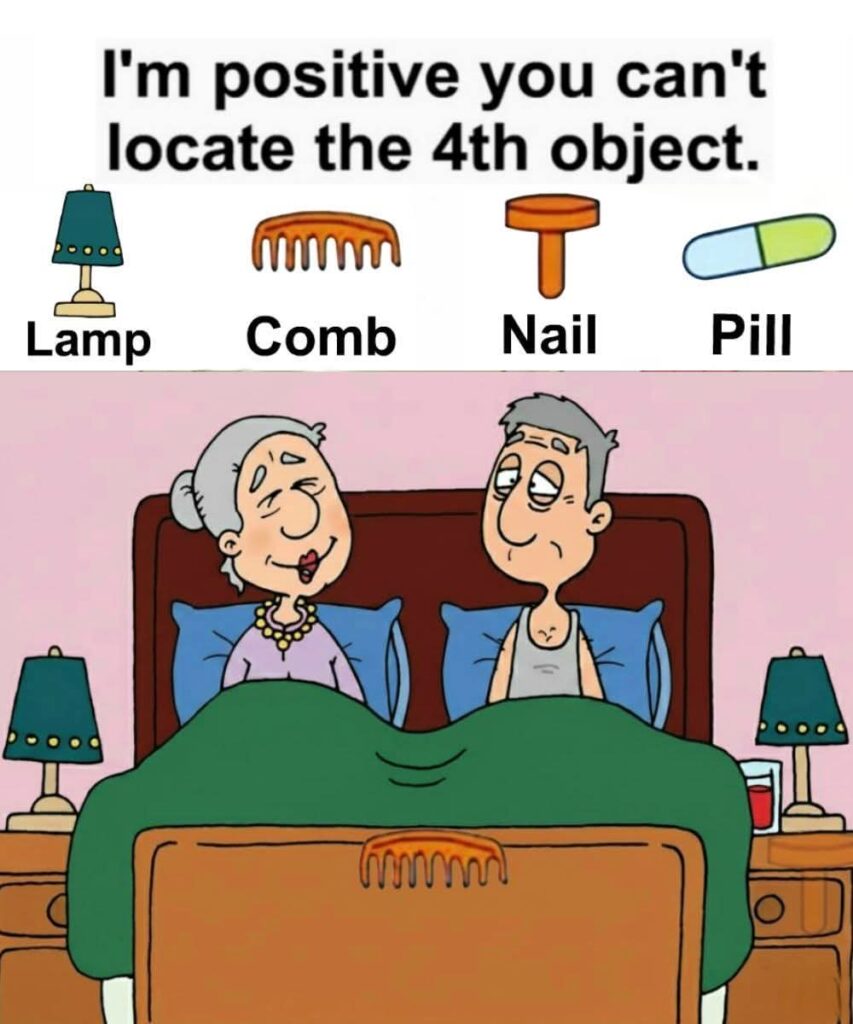
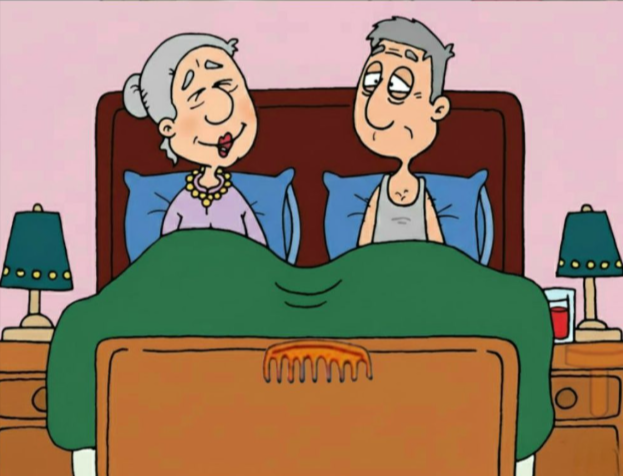
What looks like a peaceful cartoon of an elderly couple relaxing in bed is actually a clever brain teaser hiding several objects in plain sight. At first glance, most people immediately notice the obvious details—the blankets, the furniture, the bedside lamps—but the real challenge begins when you try to spot every hidden item tucked into the scene.
The puzzle asks viewers to find four specific objects: a lamp, a comb, a nail, and a pill.
It sounds simple enough. In reality, many people stare at the image for several minutes before realizing they missed one of the hidden details entirely.
The lamps are the easiest part of the challenge. They sit openly on the bedside tables, almost daring you to move on too quickly. The comb is also fairly visible once your eyes travel toward the foot of the bed, where it blends naturally into the lower part of the scene.
The nail takes more concentration. It is cleverly worked into the design, often disguised within furniture lines or background details, making it easy for the brain to dismiss it as part of the illustration itself.
But the object that frustrates almost everyone is the pill.
That’s because hidden-object puzzles rely on the way human attention works. Our brains are trained to focus on larger, recognizable elements first. We naturally overlook tiny shapes, subtle outlines, and objects that blend into surrounding colors or patterns.
The pill is not actually invisible. It is simply placed where your eyes are least likely to stop. In most versions of the puzzle, it appears near the right bedside table, partially blending into a cup, glass, or nearby object.
That tiny visual trick is enough to fool countless people on the first attempt.
If you ever struggle with puzzles like this, the best approach is to stop scanning quickly and instead examine the image section by section. Slow observation works far better than rapid searching. Hidden objects are often disguised as shadows, outlines, or decorative details rather than standing out clearly on their own.
These puzzles are more than simple entertainment. They sharpen concentration, improve visual memory, and train the brain to notice details that are usually ignored in everyday life. That’s one reason they remain so popular across generations—they combine relaxation with a satisfying mental challenge.
And the best part is that even when you miss an object the first time, spotting it later gives your brain a small reward moment that feels surprisingly satisfying.
So, if you only found three objects at first glance, you’re not alone. Most people do.
Sometimes the answer is not truly hidden.
It is simply waiting for you to look a little closer.
FAQ
Why are hidden object puzzles so difficult?
They challenge visual attention and force the brain to separate important details from background distractions.
What is the hardest object to find in this puzzle?
Most viewers struggle to find the hidden pill because it blends into nearby objects and colors.
Do brain teasers improve memory?
Yes. Studies suggest puzzles can help improve concentration, observation skills, and short-term memory.
Why do optical puzzles go viral online?
People enjoy testing themselves and sharing challenges with friends, especially when the answer seems obvious afterward.
Disclaimer: This article is intended for entertainment and educational purposes only. Puzzle interpretations and hidden object placements may vary depending on image versions and illustrations.