At first, Larissa brushed off the changes in her body as something ordinary, almost mundane. At sixty-six, discomfort felt expected. She blamed indigestion, hormonal shifts, age catching up with her. Some days she joked that too much bread must be the culprit, laughing as she patted her steadily rounding belly. It didn’t frighten her. It didn’t even worry her. It felt inconvenient, nothing more.
But during a routine visit, after a series of standard tests, something changed.
Her doctor grew quiet.
He reviewed the results once, then again, his brow tightening as though the numbers refused to make sense. When he finally looked up, his voice was careful, measured.
“Ma’am… this may sound unusual,” he said slowly, “but the results suggest… pregnancy.”
Larissa laughed, a sharp, disbelieving sound. “That’s impossible,” she said. “I’m sixty-six years old.”
He nodded, uneasy. “There are extremely rare cases. Very rare. You’ll need to see a gynecologist for confirmation.”
She left the clinic stunned, the world feeling slightly off-kilter, as though reality had shifted by a few degrees. Yet beneath the shock, something quieter stirred. Recognition. Familiarity.
She had carried three children decades earlier. She knew the weight, the pressure, the strange internal awareness that came with pregnancy. And as the weeks passed, her abdomen continued to expand. There was heaviness. Fullness. On certain nights, she swore she felt movement.
Deep down, she believed.
She didn’t rush to a specialist. She didn’t feel urgency. Instead, she trusted her body the way she always had.
“I’ve done this before,” she told herself. “When the time comes, I’ll go to the hospital.”
Months slipped by. Her belly grew undeniable. Neighbors whispered. Some asked outright. Larissa smiled serenely and said perhaps God had chosen to bless her again, late in life, for reasons only He understood.
She began to prepare.
She knitted tiny socks in pale blues and yellows. She browsed baby names, lingering over each one. She bought a small crib and placed it near her bedroom window, where morning light spilled gently across the floor. The idea of new life gave her comfort, purpose, something warm to hold onto.
By her own careful counting, she reached what she believed was the ninth month.
Only then did she make an appointment with a gynecologist, ready—nervous but calm—to prepare for delivery.
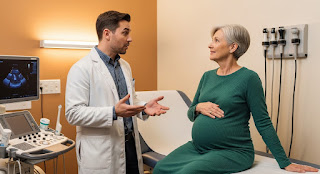
The doctor was cautious from the beginning. Her age alone raised concern. Still, he proceeded with the examination, guiding the ultrasound probe into place.
When the image appeared on the screen, the room went silent.
The color drained from his face.
“Mrs. Larissa,” he said quietly, “that isn’t a baby.”
Her heart slammed against her ribs. “Then what is it?” she whispered.
He took a breath, steadying himself.
“You have a lithopedion,” he explained. “It’s extremely rare. It happens when an ectopic pregnancy ends and the body, unable to expel it, protects itself by encasing the fetal tissue in calcium. Over time, it hardens—essentially turning to stone.”
Her mind reeled.
“This likely occurred decades ago,” he continued gently. “Your body sealed it off. It remained dormant. Only now has it grown large enough to cause symptoms.”
Larissa stood frozen, the room blurring at the edges.
For months, she had believed she was carrying new life.
Instead, she had been carrying the silent remains of a pregnancy her body had lost long ago—one she never knew existed, one that had quietly stayed with her for years, hidden beneath layers of time.
Surgery followed. It was complex, delicate, but successful.
When she woke afterward, groggy beneath hospital lights, she braced herself for grief, for devastation, for emptiness.
What she felt instead was something softer.
Relief.
A sense of closure she hadn’t known she needed.
What she had carried was not a miracle waiting to be born.
It was a chapter her body had already ended, gently, quietly, on its own terms.
And as she healed, as the weight inside her was finally gone, Larissa felt lighter—not just physically, but emotionally.
As if her body had finally let go of a story it had been holding onto for far too long.
Disclaimer: This article is a fictionalized emotional and medical-style narrative created for storytelling and educational entertainment purposes. It is not intended to provide medical advice, diagnosis, or treatment. Readers experiencing health concerns should consult qualified healthcare professionals.